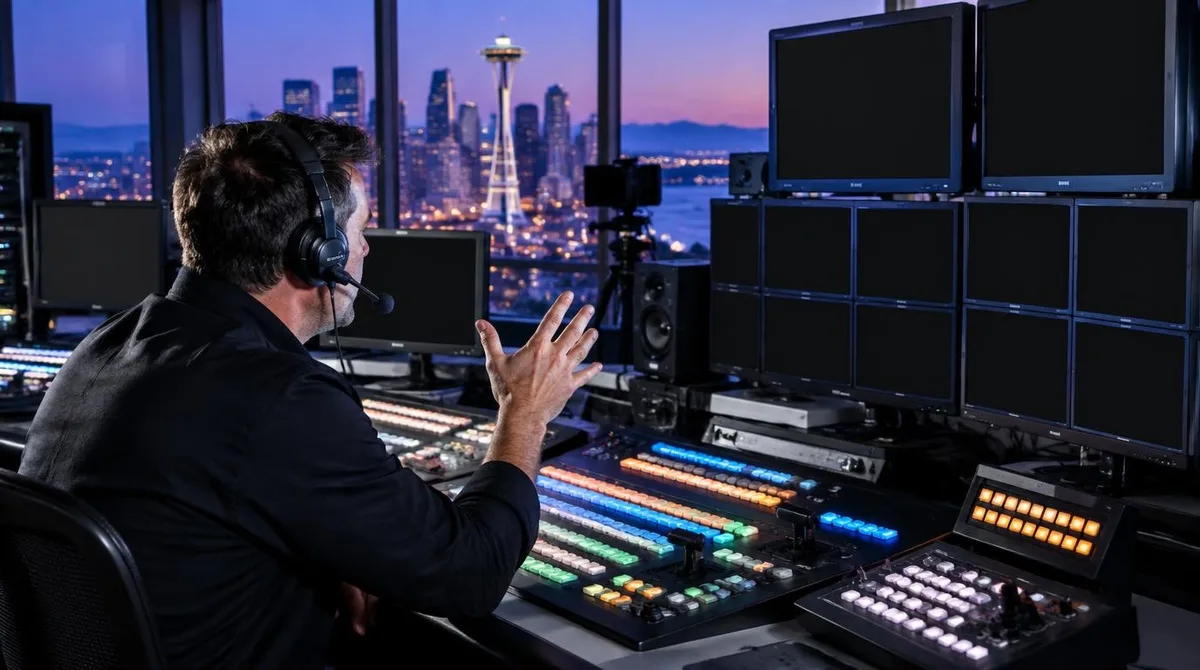
Riot Games says every show it produces is now fully remote, and the evidence backs the claim: the League of Legends World Championship Grand Final at Barclays Center on Saturday was produced almost entirely from the company's Remote Broadcast Center in Seattle, powered by AWS, plus control rooms in Los Angeles. Despite the event's scale, Riot needed only a two-truck compound onsite and a one-day load-in. That is a real milestone — but it is also a milestone reported largely in Riot's own words, and the trade-offs behind it are worth weighing.
The story comes by way of Sports Video Group, which detailed the company's shift to what it calls Contribution 2.0: low-latency, low-bandwidth HEVC encoding on Sony's NXL-ME80 media edge processors. The upgrade replaces Riot's first-generation remote strategy, which ran on JPEG XS over dual 10-Gbps last-mile circuits. The headline numbers are striking: contribution capacity dropped from nearly 10 Gbps to closer to 1 Gbps. For readers who follow festivals and large live events, this is the same infrastructure question that haunts every big broadcast — how much can you do from far away?
What actually changed, and why?
Two problems pushed Riot off JPEG XS, according to Principal Infrastructure Engineer James Wyld. The first was bandwidth. "JPEG XS for us was high bandwidth: a handful of paths out of the arena occupies the better part of 10 gigs, and we couldn't support more than about 30 paths," he told the trade outlet. The second was resilience. Riot's network is built as a mesh rather than a dual-path network, and JPEG XS contribution was single-ended with an SRT-based fallback — a failover that could leave gaps of a couple of seconds when paths switched. This connects to our earlier piece, What 'Premiere' and 'World Premiere' Status Actually Mean at Film Festivals. This connects to our earlier piece, What 'Premiere' and 'World Premiere' Status Actually Mean at Film Festivals.
The ME80 addresses both. Its encoders run active-active, with one leg on Riot Direct, the global network Riot built for its games, and the other backed up over the open internet through a VPN. Wyld's own framing is telling: with bandwidth no longer the limit, "it's just the number of encode channels you've got." That is a genuine gain — but note that the resilience fix depends on a VPN over the public internet as one of two legs. The old system's weakness was a fallback path; the new one's second leg is, by definition, a less controlled one.
How much of this is verified, and how much is the company grading its own homework?
Most of the quantitative claims here trace to two Riot employees, Rybalko and Wyld, speaking to a single outlet. Sony's ME80 gets strong marks from Wyld — "seeing it stand next to JPEG XS and be almost the same is unreal" — but Riot got in early with Sony on the processor's development and tested it itself. That is not disqualifying; it is simply the shape of the evidence. A company is the authoritative source for what it built and what it spent, and a skeptical reader should hold the performance comparisons at exactly that weight until an independent party measures them.
The same caution applies to the milestone itself. Riot says every show is now fully remote, and that VCT Champions in China last month became its first fully remote-produced global show from that country — the last holdout, after last year's LoL Worlds Final in Chengdu required eight onsite mobile units. The progression is coherent and internally consistent. It is also, again, the company's own account of its own rollout.
What are the trade-offs nobody is emphasizing?
The clearest one is embedded in the flypack story. Riot's current flypacks, first deployed in Paris and used at Barclays, are described by Senior Manager of Broadcast Engineering Alex Rybalko as "always a bit of a stepping stone." Next year's generation drops baseband altogether — full SMPTE ST 2110 to the edge, SDI reduced to gateways at the device, and a deliberate blurring of the line between venue equipment and data-center equipment. In other words, the current setup that produced the Barclays final is already scheduled for replacement. The milestone is real, but it is a snapshot of a system in motion.
The second trade-off is scope. Despite all this remote capacity, gameplay and studio production still took place onsite, and the backend ran out of Seattle. Fully remote here means the production backend, not the absence of a substantial onsite footprint — two trucks, a compound, and a one-day load-in still had to happen, and someone still had to be in Barclays Center.
Where is this headed next?
Riot's roadmap extends beyond REMI production. The company continues to push into 9:16 vertical video, co-streamer integration in live broadcasts, and soon IRL streaming that lets onsite talent go live from anywhere at any time. Contribution 2.0's full rollout brings 72 outbound and 24 return channels on the Nevion platform, still built on the ME80 technology. According to Sports Video Group, Rybalko tied the increased capacity and unified platform to what Riot expects will be its next generation of kits.
The measured read is this: Riot has done something genuinely difficult, and the numbers — a tenfold bandwidth reduction, a two-truck footprint for a global final — hang together. Rybalko, per Sports Video Group, described the company as always having been on the bleeding edge, with the industry firsts paying off in tangible results. The open questions are durability and independence. Whether the HEVC path holds up under real failure conditions, and whether the performance claims survive outside testing, will matter more over the next few years than the milestone announcement itself. For now, the honest summary is that Riot's account is detailed, specific, and entirely self-reported. For related coverage, see How to Read a Festival Lineup: Slots, Sections and Signals.