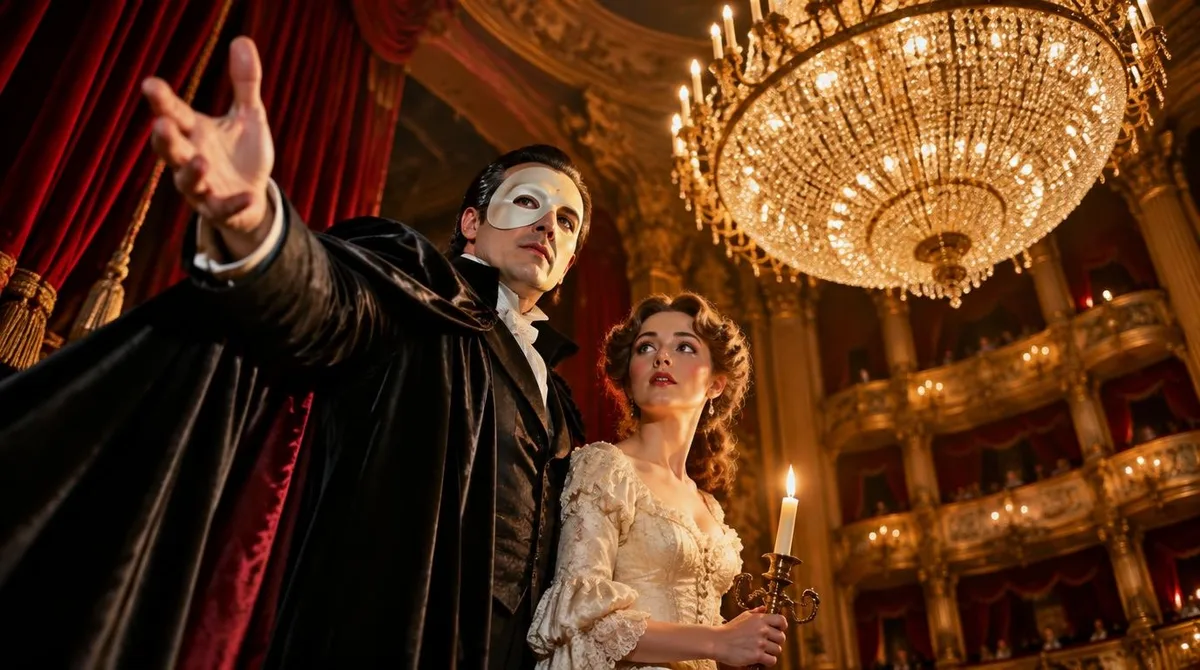
The Phantom of the Opera (2004 film) opened with a question attached: why film a stage musical that tens of millions had already seen? Andrew Lloyd Webber's show began at Her Majesty's Theatre in London on 9 October 1986. Joel Schumacher answered for Warner Bros. in December 2004 by treating the camera as a better seat, not a rewrite.
That choice is the whole review. Judged as normal cinema, the film can feel stiff and loud. Judged as a record of a show meant to be felt in the body, it works more often than its reputation claims. The two standards give opposite verdicts. So this review judges The Phantom of the Opera (2004 film) on the terms it set for itself. This connects to our earlier piece, X (2022 film) Review: Ti West's Slasher Cuts Both Ways.
The Phantom of the Opera (2004 film) meets its audience halfway
Schumacher wrote the script with Lloyd Webber, and their changes are small. The score arrives intact. What changes is access: faces where a theater gives figures, and close-ups where the crowd sits far away. The opera house itself was built for angles no seat could buy.
The opening states the bargain in one bold stroke. The film starts in 1919, in faded black and white, at an auction of the old house's remains. A chandelier is unveiled, and as it rises the dust rolls back into the full color of 1870 while the orchestra swells. It is the film's best idea: the past restored before our eyes.
From the mirror to the lair
The first act builds the way it must, through Christine's rise. Emmy Rossum, still a teenager during filming, plays the chorus girl led from the ballet line by a voice she believes is her dead father's angel. The trip through the mirror and down to the underground lair, with candles rising from the water, keeps the stage images while the camera finds them at walking pace.
Patrick Wilson's Raoul is warmer and less stiff than the role often reads, which matters: the triangle needs a live option besides the masked man below. Miranda Richardson's Madame Giry moves through the plot with the tired air of a woman who has seen this disaster coming for years. Minnie Driver's Carlotta, the diva undone by sabotage, is the film's comic engine, and her fury is funny on purpose.
The casting bet: youth over polish
The film's biggest gamble was casting young rather than casting operatic. Gerard Butler's Phantom is a rock-voiced, wounded man, and his singing still divides viewers. The choice narrows the gap between the Phantom and the lovers around him: this is a story about damaged young people, not about monuments. Rossum, trained at the Metropolitan Opera as a child, sings with startling ease.
Scene by scene, the bet pays off unevenly but honestly. Music of the Night, staged as a slow seduction in candlelight, works because Schumacher lets it run as pure spectacle. The rooftop love duet gains real tenderness from winter light and open sky. Masquerade, the show's biggest crowd scene, trades the stage staircase for a swirling waltz of costumes.
What the camera adds, and what it fusses over
Schumacher's worst habit is decoration: mist, gold, snow, and candles used past all reason. His best habit is mercy with pain. The unmasked face is shown briefly, and the camera does not gloat. A cemetery sword fight the stage never tried shows the film earning its medium in short bursts.
Sound does heavy lifting in The Phantom of the Opera (2004 film). The orchestra is warm, the singers are close, and the film trusts the music where a plainer director would cut away. The result feels like a recorded performance, which is the point.
The climax on its stage terms (spoilers ahead)
Spoilers follow. The final act compresses the ending into one hard argument. The Phantom forces Christine to choose between Raoul's life and her freedom, and her kiss, given freely to the monster, breaks him. The scene plays with real pain because the film spent two hours insisting these are young people in over their heads.
The coda returns to 1919 and to black and white. Decades later, a red rose and the ring the Phantom pressed into her palm rest on Christine's grave. The last image argues that his love outlived every rule that condemned it, and it lands.
Conclusion: faithful to a fault, and proud of it
The Phantom of the Opera (2004 film) is not a great film by the rules of original cinema, and it is a strong one by the rules it chose: a faithful, sensual record of a stage landmark, carried by a young cast that keeps the melodrama alive. Roger Ebert gave it three of four stars in December 2004, and that measured verdict still fits. Viewers who want the show will find it here, close enough to touch. Those who want it reinvented should keep walking past the mirror.